CRIME AND PUNISHMENT IN AMERICA, NEW DOCUMENTARY FROM LYNN NOVICK, TO AIR ON PBS IN NOVEMBER 2026
by PBS Publicity• Published on April 28, 2026
Four-Part, Eight-Hour Series Explores American Criminal Justice from Colonial Era to Present
Samuel L. Jackson, Laura Linney, Bobby Cannavale, Matthew Rhys, Michael Stuhlbarg, David Hyde Pierce, and BD Wong Provide Voices
ARLINGTON, VA (April 28, 2026) – CRIME AND PUNISHMENT IN AMERICA, a new four-part, eight-hour documentary series that explores the history of criminal justice in America — from the pre-colonial period to 21st century mass incarceration — will air over four consecutive nights on PBS beginning November 16, 2026, the network announced today. The series will also stream on all PBS digital platforms for a period of four weeks. A first look clip from the film is available here.
The series, directed by Lynn Novick (THE VIETNAM WAR, HEMINGWAY, COLLEGE BEHIND BARS, THE U.S. AND THE HOLOCAUST), executive produced by Ken Burns and Sam Pollard, produced by Lucas Frank, Vanessa González-Block, Lynn Novick, and Prisca Pointdujour, is the first documentary offering a comprehensive examination of how the intertwined forces of law, power, race, and class have both shaped and reflected the American experience over four centuries.
At once expansive and intimate, CRIME AND PUNISHMENT IN AMERICA seeks to answer a deceptively simple question: “How did we get here?” In doing so, it explores the architecture of justice — prisons, police, courts — and the profound moral and social questions beneath them. What are the root causes of crime? How has justice been meted out in a country founded on ideals of liberty, equality and the rule of law, yet haunted by histories of slavery, segregation, and surveillance? Why have Americans always been fascinated by outlaws and criminals? How did the fear of violent crime become one of the most potent forces in American life? How, in the late 20th century, did the United States become the world’s leading incarcerator?
“Americans have been debating the root cause of crime, the purpose of punishment, and the meaning of justice since colonial times,” said director/writer Lynn Novick. “Understanding the history of our criminal justice system in all of its complexity — and from many points of view — is essential if we want to improve public safety, reduce violence, tend to the needs of victims, and foster rehabilitation and healing of those who have committed serious crimes.”
“We’ve grappled with crime and punishment since before our founding,” said executive producer Ken Burns. “While this is not a uniquely American issue it is unfortunately one we’ve struggled with largely unsuccessfully. It is also completely woven into the fabric of American life, a place where violence has often been glorified and racism too often tolerated. Lynn’s film asks all of us to try to understand why this has been such a challenging topic for our country and invites us to come together in conversation about what we can do going forward.”
“Nearly every story about life in America is connected to a larger story about crime and punishment,” said executive producer Sam Pollard. “From the extraordinary violence connected to slavery, to the treatment of Native people and later myths about the wild west, our national story is constantly bumping up against one that we’ve failed to solve. How do we create a more just, safer society for all Americans?”
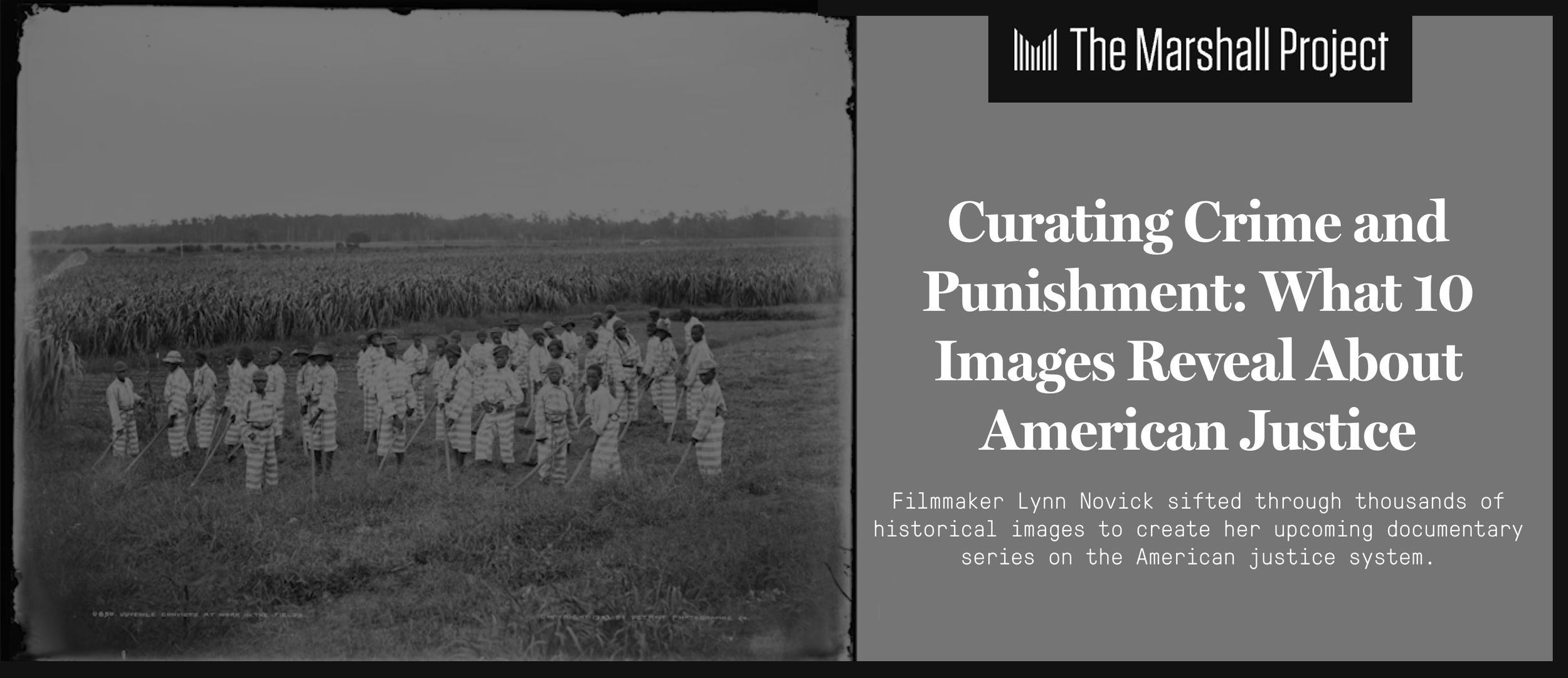
Told through a deeply human lens, each episode is grounded in the stories of individuals — incarcerated people, victims and family members who’ve been affected, prison guards and wardens, police officers, reformers, lawyers, judges, outlaws, and journalists — whose lives were shaped by the policies and politics of their time. From the public hangings in Colonial America to Franklin D. Roosevelt and J. Edgar Hoover’s war on crime, from Jesse James to John Dillinger, Lucky Luciano to Frank Costello, from early television police procedurals to modern day true crime, from Jim Crow chain gangs to the silent corridors of today’s supermax prison facilities, the series illuminates both the visible and invisible legacies of punishment in American life.
The series features evocative archival footage and first-person voices drawn from letters, memoirs, and testimony brought to life by acclaimed actors including Samuel L. Jackson, LaTanya Richardson Jackson, Laura Linney, Hugh Dancy, Bobby Cannavale, David Hyde Pierce, Matthew Rhys, Michael Stuhlbarg, Jon Proudstar, Corey Stoll, Bill Camp, and BD Wong. Original music by Jongnic Bontemps, with additional original music by David Cieri, cinematic photography, and expert interviews enrich the film’s tapestry, offering historical insight and emotional resonance.
As in her previous work, Novick collaborates with a distinguished advisory team of scholars, formerly incarcerated advocates, legal experts, and cultural historians, including senior advisor and Pulitzer-Prize winning author Heather Ann Thompson; poet, attorney, and MacArthur fellow Reginald Dwayne Betts; Vice President of Criminal Justice Policy at the Texas Public Policy Foundation Marc Levin; Yale Law School professor James Forman, Jr.; sociologist Bruce Western; and Rashaan Thomas, a writer and filmmaker.
In addition, subject matter experts representing a wide range of perspectives appear on screen, including former New York and Los Angeles Police Commissioner William J. Bratton, retired Supreme Court Justice Stephen Breyer, civil rights attorney Sherrilyn Ifill, senior fellow at the Manhattan Institute Rafael Mangual, Philadelphia District Attorney Larry Krasner, former correction officers Stephen B. Walker and Mike Jimenez, Director of the American Conservative Union Foundation’s Center for Criminal Justice Reform Pat Nolan, and founder of the Equal Justice Initiative Bryan Stevenson, among others.
From the American Revolution onward, Americans have argued about whether the goals of the criminal justice system should be punishment, rehabilitation, or both. Reformers like Benjamin Rush envisioned a more humane and enlightened justice system, in which punishment would be proportional to crime. Instead of being whipped, shamed, or executed in the public square, ordinary people who broke the law would be confined for a time in what was called a "house of repentance," and later a “penitentiary.” There, they were to learn “habits of industry,” repent for their misdeeds, and return to society reformed.
The nation’s first penitentiary, the Walnut Street Prison, opened in Philadelphia in 1790 with Auburn, Sing Sing, and the monumental Eastern State Penitentiary soon to follow. America’s penitentiary system attracted interest from near and far, including visits from Charles Dickens, Alexis de Tocqueville, and Gustave de Beaumont.
Slavery also shaped America’s practices of punishment. The plantation, Frederick Douglass said, was a “little nation of its own” untouched by the laws of the state, where the enslaved were subjected to brutal physical chastisements with no due process. Throughout the nation, enslaved and free Black people lived in fear of white militias, town guards, and slave patrols. After the Civil War, Reconstruction offered renewal, hope, and opportunity, but by the late 19th century, throughout the Jim Crow South, that promise was eclipsed, as new systems emerged that criminalized and controlled Black Americans through segregation, disenfranchisement, and vigilante violence.
Though America had led the world in establishing penitentiaries, the nation’s vaunted prisons largely failed to deliver rehabilitation. In most cities, police forces served at the behest of corrupt political machines, relying on the “third degree” — coercive, and often abusive, interrogation methods — to extract confessions. By the late 19th century, progressive reformers began exposing the cruelty, brutality, and corruption throughout the criminal justice system, and advocating for reforms and fairer alternatives.
The series includes the stories of many individuals, well known and less so, such as George Appo, the son of a Chinese father and Irish mother, who grew up in one of New York’s poorest neighborhoods. His life spanned newsboy work, pickpocketing, prison, exposing police corruption, and eventually reform. His remarkable memoir, voiced in the film by BD Wong, offers a rare firsthand glimpse into 19th-century criminal life. Appo’s story coincides with a period when urbanization and pseudoscience — including eugenics and the idea of a "criminal type" — fueled stereotypes of immigrants as dangerous.
Prohibition birthed a new breed of criminal — the wealthy, media-savvy mobster. Figures like Al Capone, Meyer Lansky, and Lucky Luciano formed a secret national crime syndicate to avoid turf wars. The U.S. government didn’t acknowledge its existence until the 1950s, when the televised Kefauver Committee hearings warned of a powerful criminal organization known as the Mafia.
The 1950s and 60s also saw the convergence of civil rights and civil unrest, as Americans demanded greater rights for African Americans in the South and cities in the North exploded with violence, renewing calls for law and order that reverberated into the 1970s.
While the uprising at Attica prison garnered national attention, drug addiction and violent crime were on the rise in American cities, leading voters to support politicians promoting harsher laws. Meanwhile, with the closure of asylums across the country, many experiencing mental illness found themselves funneled into the criminal justice system. Through this mix of forces, economic ups and downs, and under both political parties, at the end of the 20th century the U.S. built more prisons and incarcerated more and more people, particularly people of color, immigrants, and the impoverished.
The final episode centers on individuals whose personal stories reflect different facets of justice: a legislator convicted of bribery; a man imprisoned at 16 for carjacking; a woman sent to prison while pregnant; and a man who served 22 years for murder. Their testimonies — alongside those of corrections officers, a police commissioner, a district attorney, and two women who lost their sister to a high-profile violent crime — offer a human portrait of crime, punishment, vengeance, and mercy.
The broadcast of CRIME AND PUNISHMENT IN AMERICA will be accompanied by a collection of media-rich educational materials for teachers on the Ken Burns in the Classroom hub on PBS LearningMedia. This collection will include videos, primary sources, and support materials to allow teachers in grades 9-12 to explore key topics in U.S. history, U.S. government, criminal justice, contemporary issues, and/or English through the history of crime and punishment in the United States.
CRIME AND PUNISHMENT IN AMERICA will be available to stream on all station-branded PBS platforms including PBS.org and the PBS App, available on iOS, Android, Roku streaming devices, Apple TV, Android TV, Amazon Fire TV, Samsung Smart TV, Chromecast and VIZIO. The series will also be available to stream on PBS Passport and the “PBS Documentaries Prime Video Channel.” For more information about PBS Passport, visit the PBS Passport FAQ website.
CRIME AND PUNISHMENT IN AMERICA is a Skiff Mountain Films Production, in partnership with Florentine Films and WETA Washington D.C. Directed by Lynn Novick, Executive Produced by Ken Burns and Sam Pollard, Produced by Lucas Frank, Vanessa González-Block, Lynn Novick and Prisca Pointdujour, Telescript by Lynn Novick, Story by Laurens Grant, Associate Producer Ysabel Turner, Cinematography by Buddy Squires, Antonio Rossi and Christopher Loren Ewers, Original Music by Jongnic Bontemps, with additional original music by David Cieri, Edited by Dave Marcus, Ashwin Gandbhir and Jess Halee, Narrated by Keith David, Voices provided by Samuel L. Jackson, LaTanya Richardson Jackson, Laura Linney, Hugh Dancy, Matthew Rhys, Bill Camp, David Hyde Pierce and BD Wong, among others. The executive in charge for WETA is Kate Kelly.
Major funding for CRIME AND PUNISHMENT IN AMERICA was provided by The Atlantic Philanthropies, Emerson Collective, The Andrew W. Mellon Foundation, and the Park Foundation. Major funding was also provided by The Better Angels Society and its members: The Fullerton Family Charitable Fund, The Just Trust for Education, Allan and Shelley Holt, The Tow Foundation, and the Sozosei Foundation. Additional support was provided by the National Endowment for the Humanities, The Arthur Vining Davis Foundations, the William R. Kenan Jr. Charitable Fund, Ford Foundation | JustFilms, and by The Better Angels Society members: John and Catherine Debs, Timothy Fazio, Lise Strickler and Mark Gallogly, the Laurie M. Tisch Illumination Fund, Gilchrist and Amy Berg, the Carson Family Charitable Trust, Mauree Jane and Mark W. Perry, the Segal Family Foundation, and Mark A. Tracy.
About PBS
PBS, with more than 330 member stations, offers all Americans the opportunity to explore new ideas and new worlds through television and digital content. Each month, PBS reaches over 36 million adults on linear primetime television, more than 16 million users on PBS-owned streaming platforms, 53 million viewers on YouTube, and 60 million people view PBS content on social media, inviting them to experience the worlds of science, history, nature, and public affairs and to take front-row seats to world-class drama and performances. PBS’s broad array of programs has been consistently honored by the industry’s most coveted award competitions. Teachers of children from pre-K through 12th grade turn to PBS LearningMedia for digital content and services that help bring classroom lessons to life. As the number one educational media brand, PBS KIDS helps children 2-8 build critical skills, enabling them to find success in school and life. Delivered through member stations, PBS KIDS offers high-quality content on TV — including a PBS KIDS channel — and streaming free on pbskids.org and the PBS KIDS Video app, games on the PBS KIDS Games app, and in communities across America. More information about PBS is available at PBS.org, one of the leading dot-org websites on the internet, Facebook, Instagram, or through our apps for mobile and connected devices. Specific program information and updates for press are available at pbs.org/pressroom or by following PBS Communications on X.
MEDIA CONTACT: DKCCrimeandPunishment@dkcnews.com